The war in Iran has introduced major short-term issues in global ammonia supply chains. After the US and Israel launched airstrikes on February 28, 2026, Iran all but shut down the critically important Strait of Hormuz, through which roughly 20% of global oil and gas traversed in 2024 (Figure 1). Three cargo vessels were hit by projectiles on March 10th, and the ongoing threat to vessels is causing insurance rates to skyrocket. Without insurance, vessels do not leave port. As a result, vessel traffic through the Strait of Hormuz has declined by 97% from pre-war levels.
Figure 1: The Strait of Hormuz (EIA)
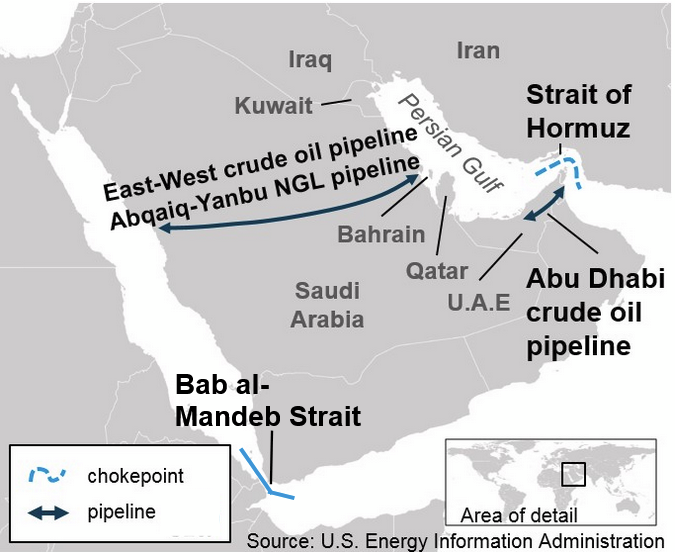
Five countries in the Middle East (Iran, Saudi Arabia, Qatar, the United Arab Emirates, and Bahrain) collectively supply about one fourth of global ammonia exports. Saudi Arabia and the U.A.E. are able to move some of their product around the Strait by pipeline, but exports from Qatar, Bahrain, and Kuwait must go through the Strait of Hormuz. Ammonia-based fertilizer prices have skyrocketed, with urea prices up nearly 50% since before the war began (from $465/tonne on 2/27 to $672/tonne on 3/23).
While the full impacts of this conflict are still difficult to predict, two long-term factors are driving the proposed ammonia buildout seen in the US in recent years: potential new markets, and government subsidies, specifically the 45Q tax credit for carbon capture and sequestration.
If fully built, proposed ammonia projects in the US would nearly quadruple national capacity from 18 million to 70 million metric tons, potentially costing taxpayers more than $5 billion in annual tax subsidies. The vast majority of this buildout would be “blue” ammonia, which is produced from natural gas using carbon capture and sequestration (CCS) to reduce the resulting greenhouse gas emissions.
The first factor driving this buildout is the industry expectation that new markets for ammonia may grow exponentially in the next few decades. Currently, fertilizers account for 70% of ammonia use globally, and 90% of ammonia use in the United States. The growth in new markets, including the use of ammonia to fuel ships or in power plants, would be a sharp departure from the present day.
The second factor is the availability of massive government subsidies for producing “low-carbon” hydrogen, the key ingredient in the process that transforms natural gas into ammonia. As covered in previous blog posts, the two primary subsidies for ammonia are 45V tax credits, which are awarded based on the amount and carbon intensity of hydrogen produced, and 45Q tax credits, which are granted based on the amount of carbon sequestered. Companies interested in claiming the 45V tax credit must begin construction on their production facilities before January 1, 2028 but those planning to rely on the 45Q tax credit have until January 1, 2033.
While many companies claim that their ammonia facility will capture and store 95% of the carbon emissions, in practice CCS rates rarely exceed 80%. “Blue” ammonia facilities would have a difficult time qualifying for even the lowest tier of 45V tax credit. This, combined with the accelerated timeline for beginning construction, makes it much more feasible for “blue” ammonia facilities to pursue the 45Q tax credit even though it is not as lucrative as 45V.
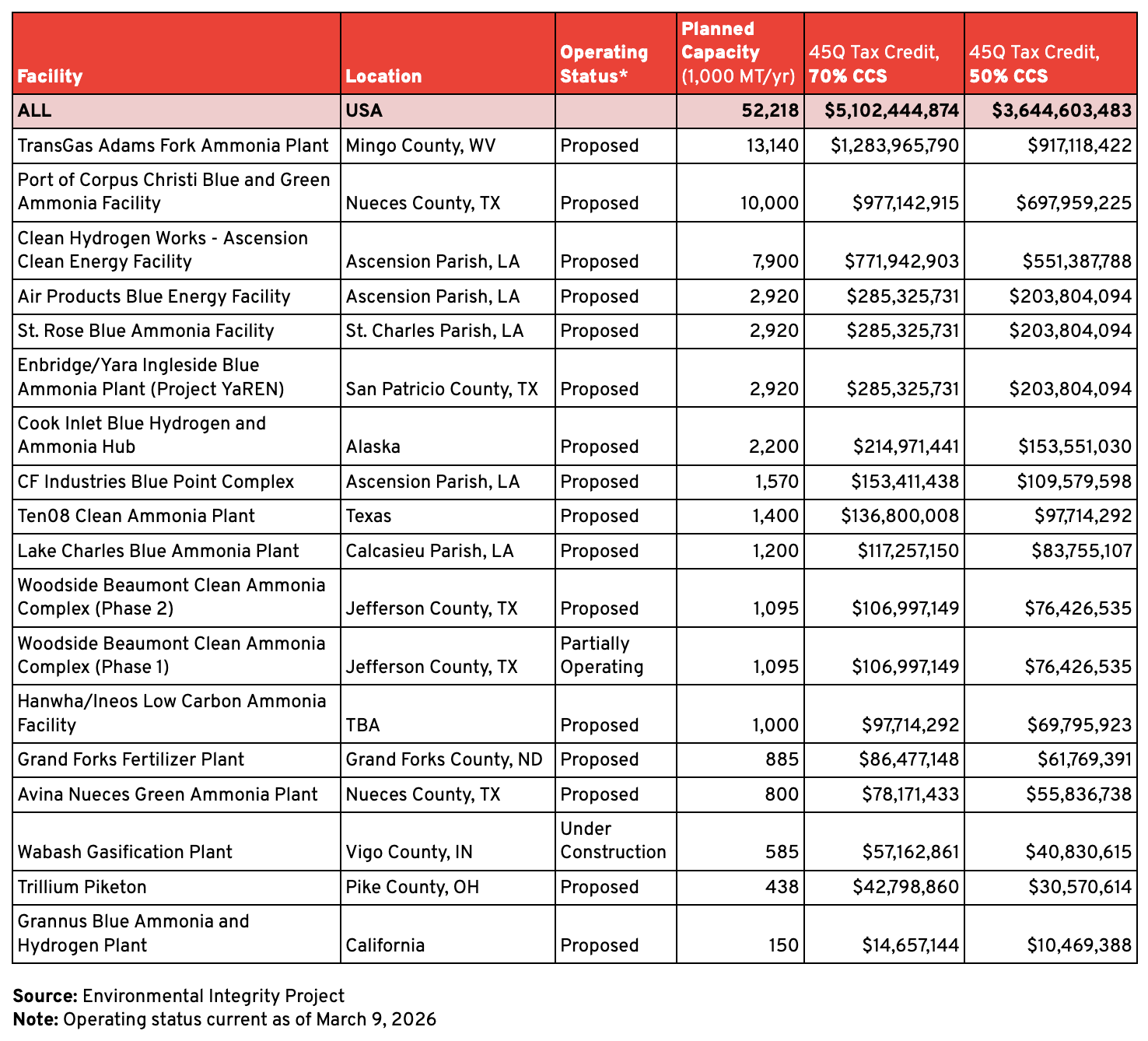
Of the 35 blue ammonia proposals in the US tracked by the Environmental Integrity Project, nine are currently on hold. Only 18 of the remaining proposals have disclosed their planned capacity (Figure 2). Using the Climate Advocate’s 45V and 45Q Calculator, I calculated how much money each of the proposed “blue” ammonia facilities would be eligible for at CO2 capture rates of 50% and 70%. Combined, the 18 projects could qualify for more than $5 billion in tax credits per year, depending on how successful CCS efforts are.
Figure 2: Locations of proposed “blue” ammonia facilities
Appalachia is home to two of these facilities: the massive Adams Fork project proposal in Mingo County, West Virginia, and the Trillium Piketon project proposal in Pike County, Ohio. If it is fully built and sequesters 70% of its carbon emissions, Adams Fork could receive nearly $1.3 billion in 45Q tax credits per year. Trillium Piketon is much smaller, yet it could still receive nearly $43 million in 45Q tax credits per year if it has a 70% CCS rate (Figure 3).
Because they are several years from operating (assuming they ever do), these facilities are unlikely to mitigate the wild price swings we’re currently seeing due to the war in Iran. Ultimately, it’s possible that a market for all of this planned capacity may never materialize, but if it does it will be taxpayers on the hook for this gas-fired ammonia production.
Figure 3: Proposed “Blue” Ammonia Facilities Could Receive More Than $5 Billion in Annual 45Q Tax Credits