
Clean Energy: No Longer Inconvenient – It’s Cheaper
Twenty Years After His Film, Al Gore Tweaks the Climate Script – by Chico Harlan – New York Times – May 25, 2026 – Mr. Gore is still giving the slide show that “An Inconvenient Truth” was built around, but with changes that reflect a shift in the discussion of climate change. And with time, the slide show has changed in ways that reflect how the conversation about climate change has shifted over the course of a generation.
Onstage in Nashville this week, Mr. Gore made a central argument that would have been inconceivable two decades ago. Rather than directly invoking morality, he led with economics. The cost of renewable energy had plunged.
He talked about “market forces” and about the “spectacular, unprecedented” technology revolution — including low-cost solar panels and wind turbines — that now make aiding the planet an affordable choice. “We’re in a different world now,” Mr. Gore said in Nashville. “The options are terrific.”
Brookings: Analysis (& Graphics) of Clean Energy Costs and State Policy
Beyond ‘clean’ versus ‘cheap’: The energy and growth strategy that states and regions are missing – By Owen Washburn, Ryan Donahue, Greer Brigham, and Xavier de Souza Briggs – The Brookings Institution – April 23, 2026
- Clean energy technologies are essentially built from the same components as digital technologies and are therefore progressing along similar learning curves that yield exponential improvements.
- Each round of hardware and software development of clean energy drives learning, innovation, and economies of scale that push costs down to the point that these technologies become too cheap to contain…Efficiency gains in the extraction of fossil fuels only have a marginal impact on costs.
- In simple terms, over time, the more oil we pump, the costlier it becomes – whereas the more solar panels and wind turbines we build and install, the cheaper they get.
The all-in cost of combined cycle gas generation in the U.S. has decreased just 5% since 2009, despite the shale boom that took off in the 2010s. Meanwhile, onshore wind and utility-scale solar costs have dropped 55% and 84%, respectively, during this period, and have been cost-competitive with or more affordable than fossil fuels for years. Battery technology and deployment have followed a similar trajectory. The cost of lithium-ion batteries dropped 93% in real terms between 2010 and 2025, driven by scaling, improved chemistry, and manufacturing learning curves.
Utility Scale Clean Energy Fuel Sources Are Cheaper
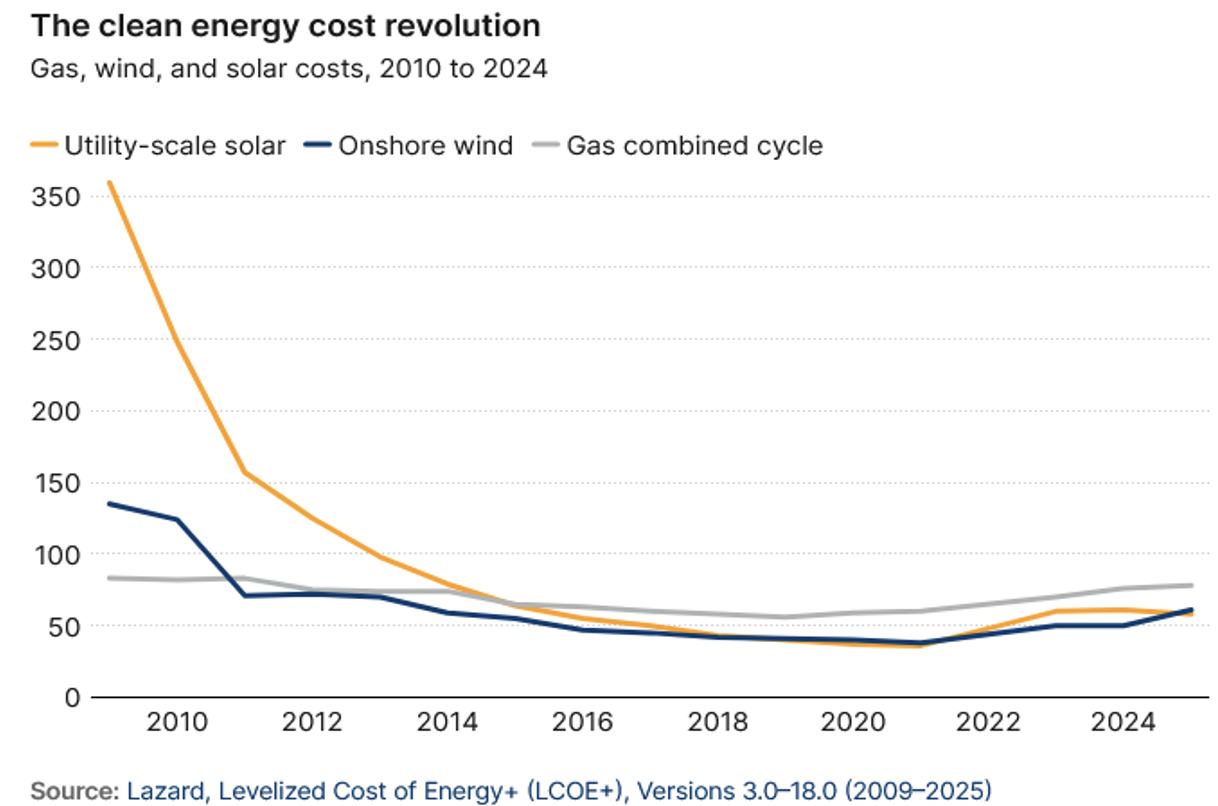
An interactive version of this graph is available at Brookings.
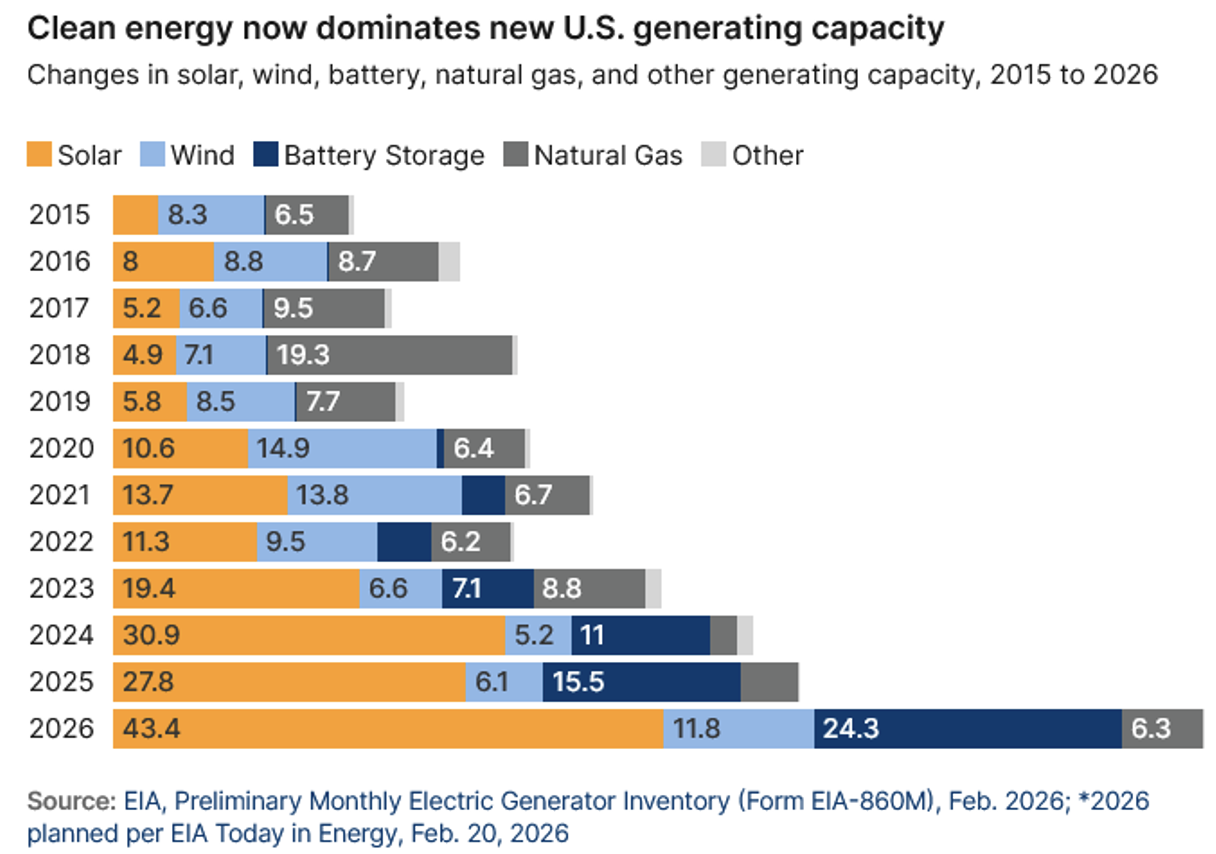
These lower clean energy costs are now showing up unmistakably in the market. In 2024, clean energy sources (solar, wind, and batteries) accounted for more than 90% of the nation’s new generating capacity for the first time – a share the U.S. Energy Information Administration (EIA) predicts will hold even as total new clean energy capacity will surge by 86 gigawatts in 2026.
The rollback of clean energy subsidies is unlikely to substantially reverse this trend, as natural gas generation – favored by the Trump administration faces multiyear supply chain bottlenecks, from turbines to transformers and other essential hardware.
Cheaper, U.S. Manufactured Batteries Lower Costs for Peak Demand
Dramatic cost decreases for batteries have made them increasingly practical for grid-scale energy storage. California, with its plentiful solar generation, large population, and summer spikes in demand for air conditioning, has already been a major beneficiary, with batteries now providing a quarter of peak load electricity. Texas, governed by very different political forces, has followed the same path, for the same market- and technology-driven reasons. Its grid operator nearly doubled its battery capacity between 2023 and 2025, adding more new battery capacity than any other state except California.
The Rest of the U.S. Has Chosen Cheaper, Clean Energy Supplies
Pennsylvania’s Bad Bet on Fuel Sources
PA’s higher electricity rates are driven by a complex (and confusing) mix of energy generation, transmission and distribution costs. A significant portion of costs are related to PA’s outdated infrastructure (the electric grid) which is overdue for upgrades & repairs to provide reliability during storms, severe weather and to supply new sources of electricity.
But one critical component of costs is the fuel source of PA’s electricity supplies. Outdated and bureaucratic rules in PA are slowing down the addition of new, cheaper and more reliable sources of power. PA’s cumbersome system has favored only one fuel source – methane (or natural gas), so much so, that 60% of our electricity now comes from gas.
Too much reliance on one source puts PA consumers at risk. The national average price of natural gas bought by electric generators increased by more than 33% in 2025. PA families are already painfully aware that oil and gas prices have increased even more in 2026.
The solution is to allow market forces to add cheaper, reliable sources like solar and wind (with US manufactured battery backup) to outperform more expensive electricity sources (like coal and gas). In the rest of the country, clean energy supplied 96% of new electricity sources in 2024, and 92% of new electricity sources in 2025 (see Chart above).
But PA has fallen behind on generating cheaper energy and now ranks 49Th in the country when it comes to electricity generated by clean renewable energy. PA is stuck in the past with a one fuel (gas) strategy. Too many elected officials in Harrisburg are ignoring private market price signals and are choosing to double down on expensive methane gas.
Why Picking Only One Fuel Source Is a Bad Strategy
Pennsylvania’s reliance on gas is one of the problems at the root of the state’s soaring electric bills, experts say, because it means PA consumers must pay more whenever global gas prices go up.
Betting on only one source of fuel is a bad strategy. For example, West Virginia relies on coal-fired electric plants for about 87% of all electricity production. As a result, WV’s average household electricity rate per kilowatt-hour has surged 73% in the past year.
Many states have pursued a strategy of diversifying their energy sources – and have been able to keep rates low while increasing electricity supplies: Texas & Iowa are two examples.
Pennsylvania should also encourage new, cheaper and more diverse energy sources.
Implementing Consumer Protections & A Diverse Fuel Strategy
First, protect consumers from Big Tech/data center price spikes and pass House Bill 1834. This will also help implement a first-of-its-kind model framework for “large energy consuming customers” (data centers) that the PA Public Utility Commission recently issued to prevent consumers from having to pick up the tab for proposed data centers.
Second, PA should encourage competition and allow clean energy entrepreneurs and businesses to build out cheaper, reliable energy sources right now and in the future.
These reforms will not happen automatically. Big Tech and oil company lobbyists are already out in full force in Harrisburg. One powerful PA elected official wants to protect and expand the 60% gas/one fuel strategy, has called for a repeal of policies that cut consumer costs, and is trying to blame other states for our high electricity prices.
Pursuing the same “all gas” approach that has brought us higher utility bills is a bad idea. Pursuing a diverse mix of cheaper, reliable clean energy fuel sources is a better idea and it is already working in states across the country. PA should enact legislation to protect consumers instead of data centers, and encourage the development of cheaper, faster and more reliable sources of clean energy and electricity.
Entrepreneurs, investors and utilities in the rest of the US are already choosing cheaper clean energy. PA should too – to help provide immediate and long-term relief to families and small businesses while providing abundant and new, reliable sources of electricity.