
New data centers are being built quickly in West Virginia. While residents are speaking out and pushing back, many communities don’t have a real say in the decisions that could impact them. These projects would use a staggering amount of fracked gas and could harm their health and environment.
A Massive Project in a Quiet Mountain Town
Figure 1: Proposed hyperscale data center campuses in West Virginia

Tucker County, located just north of the Monongahela National Forest in the heart of the Appalachian Mountains, is a tourist destination for those seeking outdoor recreation and natural scenery. It is also the site of a proposal to build a gigantic, off-grid, gas-powered, hyperscale 1.6 Gigawatt (GW) data center. Called the Ridgeline Facility, this data center would consume more than 10 million Megawatthours (MWh) of electricity each year, the same amount of electricity consumed by all West Virginia residential customers combined [1].
This massive data center would be powered by a newly built and equally large 1.6 GW fossil gas power plant. This power plant would provide “behind-the-meter,” or off-grid, electricity to the data center. Unlike most “microgrids” (see the analysis of HB 2014 below) which will have limited connection to the rest of the system, the Ridgeline Facility is expected to be completely separate from the electric grid. Being disconnected from the grid could imperil the viability of the project, because the isolation will limit revenue opportunities and increase costs needed to guarantee independent reliability.
Despite the massive size of the project, most residents of Tucker County were completely unaware of the proposal until March 2025, just as state legislators were fast-tracking a bill to promote data center development. Community members began to organize into the group that became Tucker United, but before they could get answers about the proposed facility, West Virginia’s state legislature passed House Bill 2014.
A New Law Limits Local Control
West Virginia Gov. Morrisey signed HB 2014, also known as the “Power Generation and Consumption Act,” on April 30, 2025, and touted it as making “West Virginia the most attractive state in the country for data centers… Combined with the one-stop shop permitting bill [HB 2002], companies will now be able to quickly build” data centers and their associated power plants.
In summary, HB 2014 legalized “microgrids” that produce and consume electricity separately from the rest of the electric grid. “Microgrids” are allowed to connect to the grid, but no more than 10% of their electricity is permitted to be delivered outside the microgrid district. Section 5B-2-21b of HB 2014 prohibits “[c]ounties and municipalities from imposing or enforcing local laws and ordinances concerning the creation or regulation of any certified microgrid district or certified high impact data center therein.” Further, Section 11-6N-4 requires that the state redistribute just 30% of incremental property tax revenue (new revenue derived from the higher value of the property following the construction of the data center) back to the county in which the data center is sited. Normally, counties in West Virginia retain only slightly less than 100% of the property taxes they collect. Considering the scale of these new data centers, this provision will cause county schools and offices to miss out on millions of dollars in annual revenue they would otherwise receive, according to analysis by the West Virginia Center on Budget and Policy. Moreover, half of the property taxes that data centers pay will be used to fund reductions in West Virginia’s state income tax, which will mostly benefit the state’s highest-income taxpayers.
Health Risks From Increased Pollution
In August 2025, shortly after the passage of HB 2014, the West Virginia Department of Environmental Protection issued a permit authorizing construction of the Ridgeline Facility.
A report by the Harvard T.H. School of Public Health’s Dominici Lab commissioned by Tucker United found that the Ridgeline Facility will expose more than 250,000 people to increased particulate matter pollution across northeastern West Virginia and into northern Virginia (Figure 2). The report found that the health impacts associated with increased exposure, such as heart attacks, asthma attacks, and hospitalizations, will cost $35 million annually.
Figure 2: Increased Particulate Matter (PM2.5) Pollution from the Ridgeline Facility
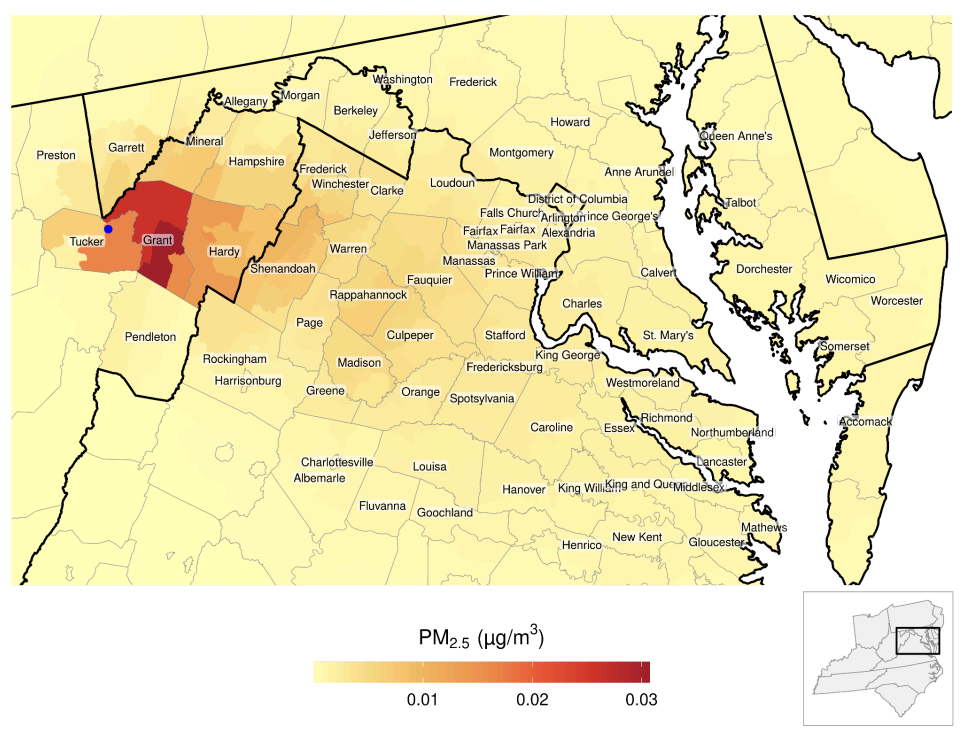 Source: Tucker United, Harvard T.H. Chan School of Public Health’s Dominici Lab
Even Bigger Projects Are Planned
Yet the proposed Ridgeline Facility is not even close to the largest proposed data center of its kind in West Virginia. That distinction belongs to the 9.8 GW Adams Fork pair of data center campuses in Mingo County, proposed by TransGas Development Systems, which has struggled to advance other projects at the same site. The second largest is the proposed 8 GW Nscale Monarch Compute Campus, located in Mason County, a few miles north of Point Pleasant. The first phase of the Monarch Compute Campus is already underway, with the facility planning to supply compute capacity to Microsoft and Caterpillar set to supply 2 GW capacity of fossil gas generators. The increase in particulate matter pollution from these sites can be expected to be similarly massive.
It is hard to overstate the size of the Adams Fork and Monarch proposals. If fully built, each of these campuses would be one of the largest in the world. Including the Ridgeline facility and the proposed 600 MW Penzance Bedington Campus in Berkeley County, West Virginia’s 20 GW total of new data center capacity would consume 123 million MWh of electricity each year [2], more than 3.7 times as much as the entire state of West Virginia, which consumed 33 million MWh in 2024.

Powered by gas, these four data centers could combine to burn more than 2.5 billion cubic feet per day, or 914 billion cubic feet per year. This is a staggering amount of gas, equal to 2.7% of all gas consumed nationwide [3].
Who Benefits, and Who Bears the Cost?
The examples of the Ridgeline Facility in Tucker County, the Monarch Compute Campus in Mason County, and Adams Fork in Mingo County expose how House Bill 2014 functions at the macro-level: Public officials tout the purported benefits of these data centers while silencing local communities and diverting millions of dollars of likely revenue from the municipalities hosting these projects.
The result so far is a data center buildout that ignores the justified outcry of the communities which bear the brunt of fossil pollution.
- West Virginia residential electricity sales totaled 10.7 million MWh in 2024, according to the EIA.
- Assuming 70% average usage.
- Total US gas consumption in 2025 was 33,523 billion cubic feet, according to the EIA.