

Recently, ORVI published a paper comparing the regional grid managed by PJM, which relies heavily on base load generating sources, including coal, natural gas, and nuclear, to a more flexible grid design, which integrates more renewable, storage, and demand-side resources and does so based on price and cost-effectiveness. The flexible model is exemplified by the ERCOT grid, which serves Texas and, which over the past decade, has managed to keep electric rates almost unchanged despite large increases in demand.
The ORVI paper suggested that PJM, West Virginia, and its other member states transition to a more flexible model that, like ERCOT’s, shifts financial risk from customers to generators and relies more heavily on market pricing to motivate utilities, generators, and transmission providers to minimize cost. The need to take this approach was recently illustrated by testimony before the West Virginia Public Service Commission on behalf of West Virginia Citizen Action Group, Solar United Neighbors, and Energy Efficient West Virginia.
Chelsea Hotaling and Jim Grevatt of The Energy Futures Group and Catherine Kunkel of the Institute for Energy Economics and Financial Analysis testified in response to an Integrated Resource Plan (IRP), filed by FirstEnergy subsidiaries Potomac Edison and Monongahela Power, in which the companies propose to build a new 1,200 MW natural gas-fired power plant to serve northern West Virginia and the state’s eastern panhandle. The problem as pointed out by Hotaling, Grevatt, and Kunkel is that the proposed power plant is a risky and expensive solution to a problem that may not even exist. But the plant proposal is also a financially rational response by the FirstEnergy companies to perverse incentives, created by West Virginia and PJM, which support base load plant construction while mitigating against flexible, non-base load resources and, which as a consequence, produce unnecessarily high electric rates.
Creating a problem to justify a solution
Although the companies modeled just 243 MW of expected load growth associated with data centers in their IRP, they make reference to “over 1 GW of expected large load additions in the Companies’ service territory that were not modeled in the IRP due to timing considerations.”[1] But both figures are doubtful and, according to Kunkel, neither justifies a 1,200 MW gas plant.
As Hotaling and Kunkel point out, the companies’ efforts to have their forecast of 1 GW or more of data center-related load growth included in PJM’s overall forecast were rebuffed due to the absence of a signed contract or identified customer. The 243 MW that are included in the IRP are similarly lacking. Meanwhile, experts in the field anticipate that as few as 10% of proposed data centers will be built.
If the added data center demand fails to materialize, Kunkel finds that the companies already have sufficient power for the period of the IRP, which extends through 2035. They also fall only slightly short of having sufficient capacity and the shortage doesn’t appear until the last two years of the period.
Table 1: Companies’ projected capacity position without 243 MW data center
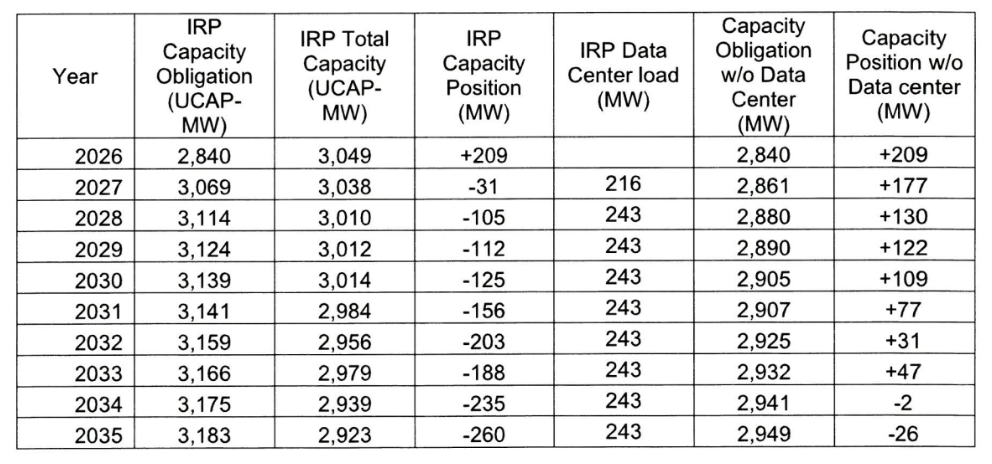
The addition of 243 MW of data center load also leaves the companies with significantly less need for generation and capacity than would be provided by a new 1,200 MW plant.
So, why do the companies want to build a power plant that they seem not to need? First, because, in West Virginia’s fully regulated electricity market, utilities earn a guaranteed return on equity for capital expenditures. According to the company’s figures, the proposed plant will cost between $3 billion and $3.7 billion to build, an amount they will be able to fully recover from ratepayers plus a profit regardless whether the plant proves to be necessary.
In other words, the risk falls not on the company and its investors, but on captive customers who have no say in the matter apart from whether the West Virginia Public Service Commission approves the IRP. And the risk is compounded by the fact that, from a cost perspective, this is the worst time in history to build new, gas-fired power plants, the cost of which has tripled in the last three years.
If on the other hand, we were in a market operating on a flexible model and in which power producers are deregulated, this scenario would not arise because investors rather than the public would shoulder the financial risk and, in the face of uncertain demand, it very likely would never be built.
Failing to explore better, less expensive solutions
The companies’ proposal is also noteworthy for all the available energy resources it does not include or, as Grevatt points out, in some cases, even examine. First, it must be noted that the IRP includes a fairly paltry 70 MW of new solar capacity out of the total 1,270 MW that are being proposed. But solar, wind, and battery storage were arbitrarily capped at 200 MW each. And demand-side generating, storage, and energy efficiency resources were not modeled at all.
That’s disappointing because in flexible models, where all resources are allowed to compete based on their ability to deliver power to the grid cost-effectively, batteries, renewables, and demand-side resources are making large inroads because they are often the least expensive resources available. And, in cases such as this one in which utilities are in need of less than 250 MW, it is well within the realm of possibility that a mix of resources, including those that were overlooked can satisfy the need without the requirement of major capital investments.
But, there is the rub. Utilities make money on capital investments and, in West Virginia, are assured of a return on capital. However, many of the technologies that received little or no consideration from the companies, require far less capital than a new power plant, making it not in the utility’s interest to propose them even if they offer power at less cost.
For that reason, it’s not surprising that the FirstEnergy companies don’t offer energy efficiency programs in West Virginia. That said, state law requires utilities to quantitatively assess energy efficiency solutions and the fact that the companies felt they could safely blow off the requirement tells you something about the regulatory environment in which they operate.
On the other hand, flexible grid markets that enable both generating and non-generating resources, both renewable and fossil fuel, to compete on a level playing field in which the ability to deliver service cost effectively is the arbitrator are seeing explosive growth in exactly the resources that the FirstEnergy companies ignored and discouraged.
How much of a difference it would make in the companies’ territories is unknown. As Hotaling put it in her testimony,
“Due to the shortcomings of the Companies’ IRP analysis, we cannot say what resource mix would best address the projected capacity shortfall. As | explained earlier in my testimony, the Companies did not model demand-side resources at all, and the Companies applied cumulative build limits to wind, solar, and storage. If the Companies had given those resources greater consideration, they may have developed a portfolio that included demand response, energy efficiency, battery storage, and/or more renewables, with less reliance on new gas resources. But without the benefit of a more even-handed analysis, we simply do not know.”
Failing to turn a critical eye on existing resources
FirstEnergy is the owner and operator of nearly 3,000 MW of coal-fired capacity at the Fort Martin and Harrison plants in West Virginia. At a time when, despite efforts to counter the trend by the Trump administration, coal plants are falling into disuse, if not retiring, coal plants in West Virginia seem strangely immune to market forces.
Although seven coal plants that are over fifty years old continue to operate, they currently do so at deeply reduced rates of utilization – regularly less than 50% of capacity – and they do so despite the inherent inefficiencies of coal-fueled generation and climbing maintenance costs as the plants age.
The situation is made possible by some analytic sleight of hand in which likely costs associated with the plants are conveniently overlooked. Kunkel explains,
“The modeling conducted in the IRP only reflects only the Companies’ projection of baseline capital and O&M costs, without incorporating the additional costs and risks associated with major repairs/replacements or future environmental compliance. By not adequately reflecting the uncertainty surrounding long-term reliability, major component replacement, and potential environmental compliance costs, the IRP may have understated the costs of continuing to operate the Fort Martin and Harrison plants.”
This is another example of a situation that would not arise in a price and cost-driven market and which results in West Virginia customers paying unnecessarily high prices for electricity. Making changes in the system and the markets upon which it relies is not without complication. Transitioning to a more flexible, market-driven system would require legislative and regulatory changes at the state level and within PJM generally. But, as this real-world case demonstrates, significant rewards are within reach if we have the wisdom, the courage, and the political will to pursue them.
[1] Companies’ 2025 IRP at 26; see also id. at 116-17; DiNicola Direct at 15.