
[button link=”https://ohiorivervalleyinstitute.naughty-cat.com/wp-content/uploads/2021/12/Stayin-Alive-2-22-22.pdf” type=”big” color=”red” newwindow=”yes”] Download report[/button] [button link=”https://ohiorivervalleyinstitute.naughty-cat.com/wp-content/uploads/2021/12/Stayin-Alive-One-Pager-2.pdf” type=”big” color=”red” newwindow=”yes”] Download summary[/button] [button link=”https://docs.google.com/document/d/1LuEdmoRof0Gws6LhufxBcdqV5qOhCycpT9AdnfhGOBQ/edit” type=”big” color=”red” newwindow=”yes”] Download digital toolkit[/button]
In recent years, there has been growing concern over the millions of oil and gas wells that are no longer producing but are threatening the environment and public health and will cost tens of billions of dollars to clean-up.
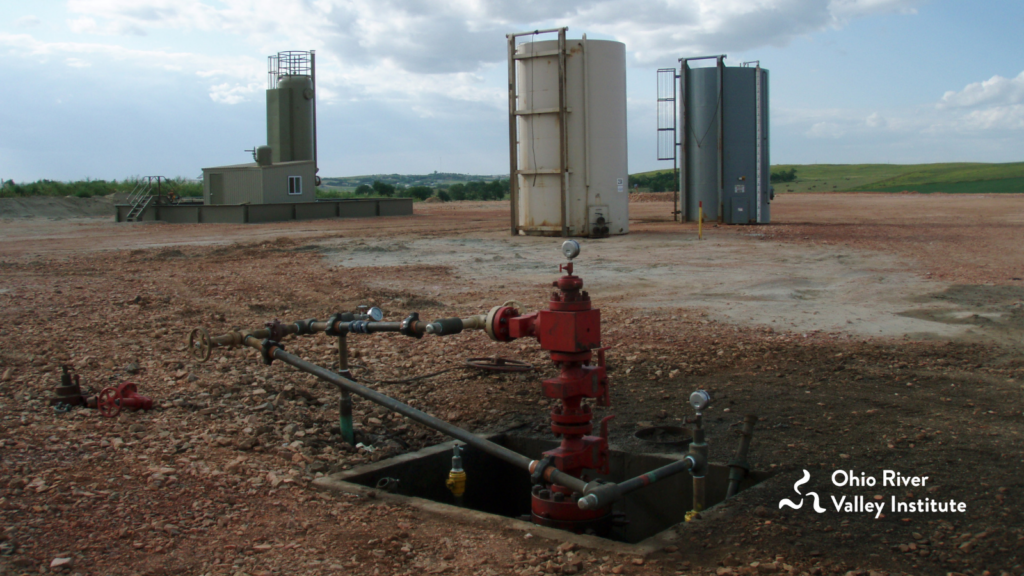
While there are already millions of non-producing wells that need to be plugged, this report shows that there could soon be a large wave of even more non-producing wells. There are over 177,000 wells in the Ohio River Valley states of Kentucky, Ohio, Pennsylvania, and West Virginia that are technically producing oil or gas – but only in small amounts. Most of these “stripper wells” are producing less than one barrel of oil or 6,000 cubic feet of gas per day. Many are near the end of their economic life but have been kept alive, sometimes for many years, at very low production levels to avoid clean-up costs. Since 2000, the number of stripper wells – or wells producing less than 15 barrels of oil or 90,000 cubic feet of gas per day – in the region has ballooned by over 40 percent while average stripper well production has declined by nearly one-third.
The problem is that, because well operators aren’t required to set aside sufficient clean-up costs upfront, states and the public could be on the hook for cleanup costs.
The growth in stripper wells or “marginal wells”, didn’t happen by accident. It was driven by a combination of policies, including tax subsidies and lax regulation to keep wells unplugged for as long as possible. Political and industry entities have long championed the preservation of stripper wells, stating that it’s better to leave them unplugged for possible future benefit, despite evidence to the contrary. To remedy these problems, states need to act swiftly to require the oil and gas industry to set aside enough money to plug their wells and restore well sites even if their owners are no longer in business.
Key Findings:
- 1 in 5 stripper wells in the United States is found in the Ohio River Valley states. Approximately 10 out of every 11 producing oil and gas well in the region are low-producing stripper wells at risk of becoming wards of the states. Since 2000, the number of stripper wells in the region has grown by 43 percent and stripper well gas production has declined by nearly one-third. Approximately 72 percent of stripper wells produce less than one barrel of oil equivalent per day (BOED).
- Most stripper wells are owned by large companies in the Ohio River Valley region, with 17 companies owning nearly half of all stripper wells. Diversified Energy with over 50,000 stripper wells is the largest owner in the region and is responsible for nearly 43 percent of all stripper well production.
- Each stripper well represents a substantial liability to the public: the average stripper well has $214 of bonding coverage while a low-end estimated to plug a well is $30,000, on average. If stripper wells were bonded at full cost ($30,000), stripper well operators would pay an estimated $134 million annually in premiums for this coverage.
- Decommissioning the estimated 177,000 stripper wells in the region would cost between $5 billion and $16 billion, yet total bonding coverage is less than $40 million.
- Stripper wells are largely exempt from state production (severance) taxes, and the federal government provides hundreds of millions in tax subsidies to stripper well operators. In 2022, the Marginal Well Tax Credit alone is expected to reduce taxes by $320 million for stripper well operators.
- The 177,000 stripper wells in the four-state region emit at least 199,000 tons of methane annually, based on regional studies. This is equivalent to the greenhouse gas emissions of 553 million gallons of gasoline.
- More than 1 in 7 – 31,000 – of the active wells in the four-state region are “uneconomical” and arguably need to be decommission (plugged and abandoned) . On top of these uneconomical wells, there are additional 192,000 inactive wells that likely need to be decommissioned.
- A small fee – between 3 to 7 cents per Mcf (thousand cubic feet) of gas produced –deposited into an escrow account over the next 25 years could provide a substantial portion of the funds needed to decommission the 405,000 unplugged active and inactive wells in the four states, even if the current operators were to walk away and leave their wells orphaned.