

[button link=”https://ohiorivervalleyinstitute.naughty-cat.com/wp-content/uploads/2025/10/Whats-Happening-with-MERP-in-Ohio-River-Valley-States_-1.pdf” type=”big” color=”red” newwindow=”yes”] View research brief[/button]
The Methane Emissions Reduction Program (MERP) was an important component of the Inflation Reduction Act (IRA). MERP was aimed at reducing greenhouse gas emissions and pollution from oil and gas operations. However, most aspects of the program have been rolled back, delayed, or dissolved. In March 2025, Congress eliminated the waste emissions charge, which required large oil and gas operators to account for some of the costs associated with this waste and pay a fee based on methane emissions leakage. The Congressional Budget Office estimated that the fee would generate $7.2 billion from 2025 to 2034.
Last month, the US Environmental Protection Agency (EPA) suspended the revisions to the Greenhouse Gas Reporting rules that required more accurate methane and waste emissions reporting in the oil and gas sector until 2034. Meanwhile, a 2024 EPA rule to require the oil and gas industry to reduce methane and VOC (Volatile Organic Compounds) emissions from operations sites is likely to be weakened by the Trump administration EPA. These three rule changes were designed to work in concert with approximately $1.5 billion in MERP financial and technical support to help states and companies plug low-producing conventional wells and implement innovative emission reduction solutions, including leak detection, and repair of well sites and infrastructure.
To help the oil and gas industry accelerate methane reduction at well sites in preparation for imposition of the waste emission charge, the IRA established two grant programs at EPA and the US Department of Energy with $1.36 billion in funding. The first program allocated $850 million to projects to reduce, monitor, measure, and quantify methane emissions from the oil and gas sector. The second program allocated $350 million in state formula grants to support voluntary efforts by industry to reduce methane by plugging low-producing onshore marginal conventional wells on non-federal land. These two MERP programs were aimed at helping the industry accelerate methane reduction at well sites in preparation for the waste emissions charge.
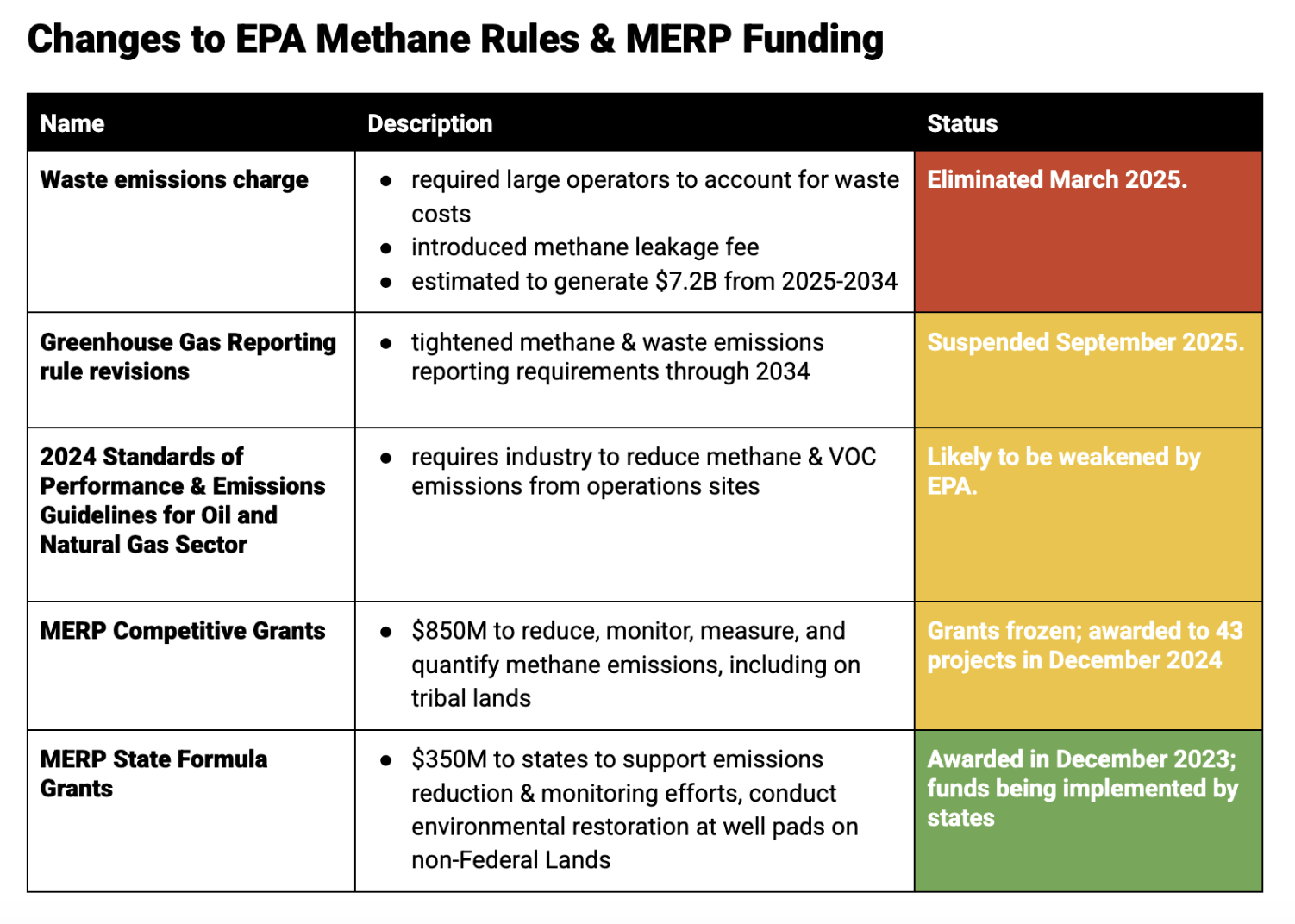
While the EPA and DOE announced in December 2024 that $850 million was awarded for 43 projects to help small oil and gas operators reduce methane emissions, these grants have been frozen. All 43 projects are also part of a “kill list” of targeted clean energy projects being considered by the Trump administration to be canceled amid the federal government shutdown. However, the $350 million in state formula grants to plug marginal conventional wells was awarded in December 2023 and states are now beginning to implement the program. Similar to the orphaned well program included in the Infrastructure Investment and Jobs Act (IIJA), award recipients are required to pay workers local prevailing (Davis-Bacon Act) wages and comply with Build America, Buy American (BABA) when purchasing construction materials and manufactured products. States are also required to measure methane emissions for each well plugged or monitored in the program and to implement a community benefits and environmental plan. The National Energy Technology Laboratory (NETL), which is located in Pittsburgh and is part of the DOE, is administering this MERP program.
Each state is implementing the MERP marginal well formula grant program differently while adhering to federal guidelines. Some states are contracting out the implementation of the program to a single company, while other states are building on their own orphaned well programs and plugging wells through the states’ bidding processes.
This research brief reviews how Ohio River Valley states—Kentucky, Ohio, Pennsylvania, and West Virginia—are implementing this program. All together these four states received $115.1 million or about one-third of the $350 million in state formula MERP grants based on their proportion (150,000) of marginal conventional wells.