
The gigantic proposed buildout of data centers across Appalachia is part of an economy-wide shift to AI. This blog post provides an overview of data centers, “artificial intelligence,” and the associated energy consumption.
What are conventional data centers?
Data centers are the physical infrastructure that enables the digital world. They have existed for decades providing services like data storage, computer processing, and network infrastructure. Whenever you upload a document or photo to a shared cloud storage service, and then a friend or colleague downloads that file to their device, that digital process is made possible by a physical data center.
Historically, conventional data centers have been relatively small, with an average data center demanding between 5 and 10 megawatts (MW) electricity. This means, up until the last few years, most data centers consumed between 30,000 and 60,000 Megawatt hours (MWh) electricity per year, equivalent to between 2,800 and 5,600 households [1].
What makes AI-specialized data centers different?
AI-specialized data centers might best be thought of as giant supercomputers. They serve a different function to conventional data centers, and they are on a different energy scale entirely.
First, as a matter of physical infrastructure, AI-specialized data centers use more advanced computer chips and pack the chips closer together to increase the speed at which data can be processed. These advanced chips require more energy to run, and packing all those computer chips close together also produces more heat, which then takes more energy (and sometimes water) to cool. These data centers occupy entire buildings, and those buildings can be combined into larger campuses.
Instead of prioritizing data storage and network infrastructure for current uses like conventional data centers, much of the energy consumed by AI-specialized data centers goes toward training new and faster AI models. The models are trained on vast amounts of data scraped from every source imaginable: books, blogs, social media posts, academic treatises, Twitter threads, YouTube videos, scientific studies. The way AI models are trained poses serious questions about privacy and ownership and has led to high-profile lawsuits against tech companies from the New York Times and prominent authors such as Jia Tolentino and Ta-Nehisi Coates.
Why are so many companies building AI-specialized data centers?
The answer sounds like science fiction but tech companies are in a race to create Artificial General Intelligence (AGI), essentially an AI-model that can do everything a human can do.
Building larger and larger data centers is a core feature of this race. Training AI models requires immense processing power, and therefore immense energy. The larger the data center, the more processing power can be harnessed to train a faster, better, “smarter” AI model. And having a faster, more “intelligent” model makes it possible to build the next, better model even faster.
Each new model promises greater potential economic return to the large corporations that own and operate them. And because AI models are advancing at an accelerating pace, tech companies want to build data centers as quickly as possible.
How much energy do AI-specialized data centers consume?
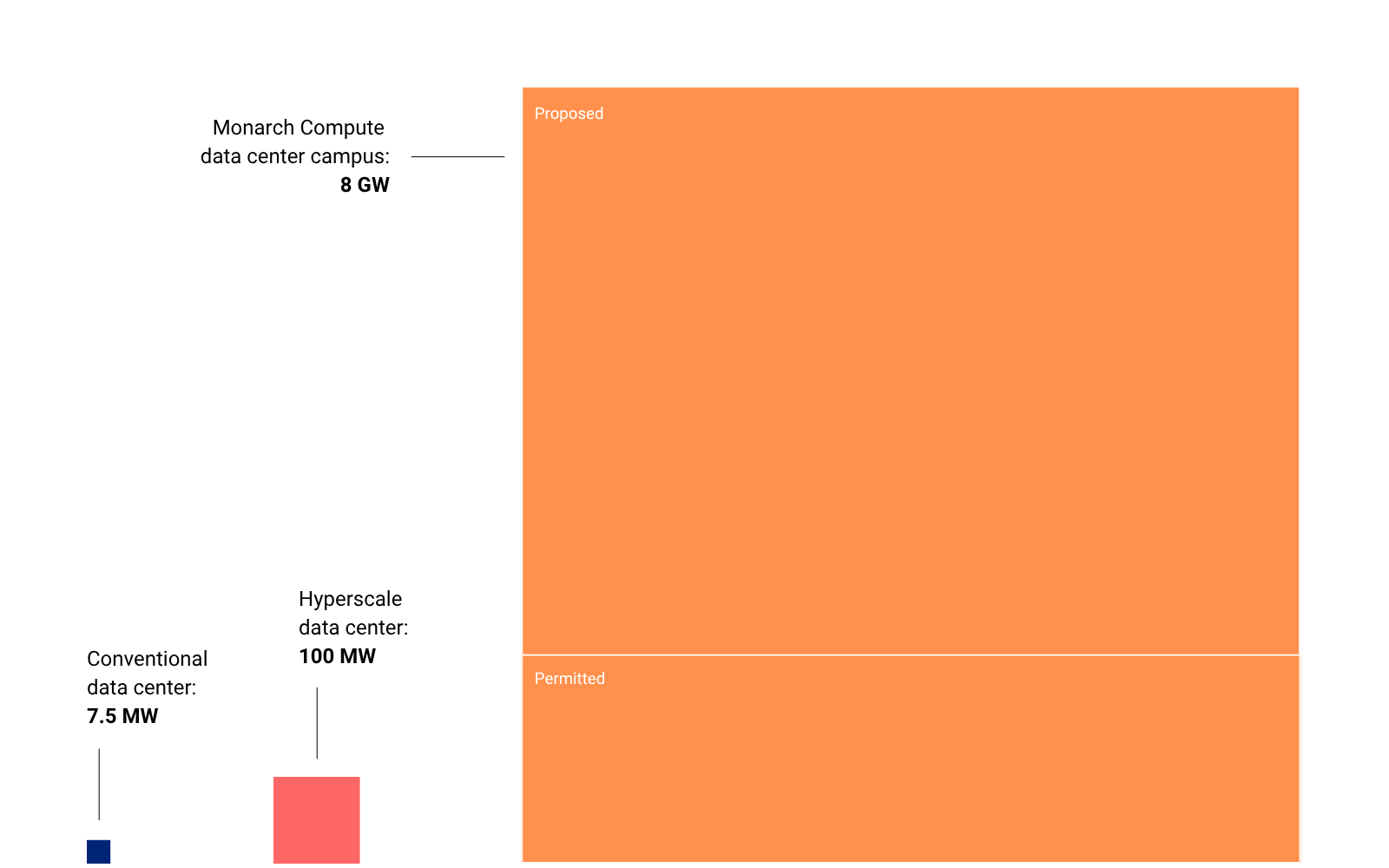
The energy required by the AI-specialized data centers dwarfs the older, conventional data centers so much that the industry uses new terminology: data centers that demand more than 100 MW are classified as “hyperscale” data centers. A 100 MW hyperscale data center consumes over 600,000 MWh electricity per year, equivalent to more than 56,000 households. This is around 10 to 20 times the size of the older, conventional data centers.
Yet a 100 MW hyperscale data center is itself dwarfed by the massive campuses being proposed across Appalachia today.
In West Virginia alone, the proposed 9.8 GW Adams Fork campuses, 8 GW Monarch Compute Campus, 1.6 GW Ridgeline Facility, and 600 MW Penzance Bedington campus show the immense potential scale of data centers. Combined, these four data centers could consume more than 123 million MWh per year, more than 3.7 times the amount of electricity consumed across the state of West Virginia in 2024.
Figure 1: New hyperscale campuses dwarf old conventional data centers
Source: Ohio River Valley Institute
Where do data centers get their power from?
Data centers typically draw power from the electric grid. But getting connected to the electric grid can take years. It often requires permits and building new power lines, which slows things down. To avoid the wait, some companies want to build their own power plants on-site or nearby. This is called “behind-the-meter” power because the electricity is used directly by the data center instead of flowing through the wider grid.
In West Virginia, House Bill 2014, passed in April 2025, legalized “behind-the-meter” power for data centers in the form of “microgrid” districts. The proposed 8 GW Monarch campus and 1.6 GW Ridgeline facility are examples of how much electricity could be produced in a “microgrid” district.
The Monarch and Ridgeline “microgrids” are part of a national trend: as of February 2026 there are at least 46 data centers with a combined capacity of 56 GW planning behind the meter electricity generation. Nationally, 75% of this behind-the-meter power, 42 GW, is expected to come from natural gas.
If all of those gas-powered projects are built, they would burn more than 5.2 billion cubic feet of gas per day, or 1.9 trillion cubic feet per year. That is equal to 5.7% of all gas consumed nationwide in 2025 [2].
Based on databases and maps maintained by organizations like FracTracker, ORVI has identified at least 49 GW of proposed data centers across Ohio, Pennsylvania, and West Virginia. And new proposals keep appearing.
Figure 2: Hyperscale data centers in Appalachia

Are all these data centers actually going to be built or is this a bubble?
As we assess the potential risks of data center proposals in the region, it’s important to remember that not all data center announcements will lead to actual facilities. Concerns that we may be experiencing an AI energy bubble, supply chain issues affecting the availability of turbines and transformers, and the significant delays in the data center sector are all reasons to think twice the next time you read a press release claiming that one of these facilities is coming to your community.
Yet the race towards data centers is already reshaping energy systems, land use, and local economies across Appalachia. Understanding how data centers work, where their power comes from, and the forces driving them, is the first step to understanding what this boom could mean for the region.