

The giant Adams Fork project keeps getting bigger. Back around 2010, the 150-acre site north of Wharncliffe, WV, was slated to become a coal-to-gas facility but construction had barely begun before it was canceled in 2011. The site remained dormant for over a decade until 2023, when TransGas announced new plans to build a massive ammonia plant fueled by natural gas.
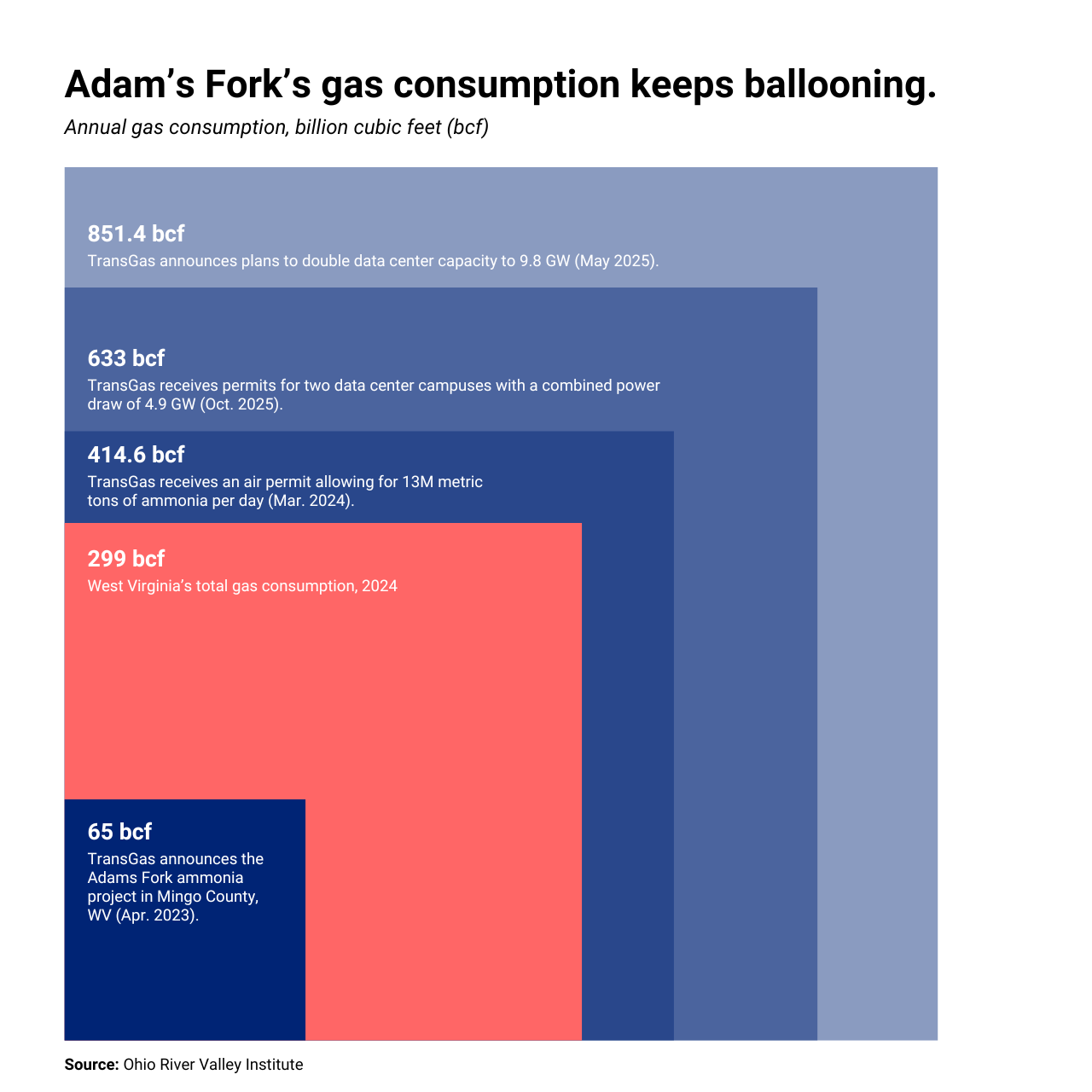
As it stands today, Adams Fork has permits to build three massive natural gas facilities. First came a March 2024 permit to build the largest ammonia plant in the country. If fully built — and it’s increasingly doubtful it ever will be — this facility would produce over 13 million metric tons of ammonia, nearly equal to the entire US ammonia output in 2022.
Producing 13 million metric tons of ammonia from fossil gas would consume more than 414 billion cubic feet (bcf) of gas per year [1]. This single facility would consume 50 percent more natural gas than the entire rest of the state of West Virginia.
Second, two October 2025 permits to build identical data center campuses outside of Wharncliffe, one at the former Twisted Gun Golf Course and one at the Harless Industrial Park. Each campus would have the capacity to consume 2,457 Megawatts of electricity. Combined, the two data centers would consume over 29.4 million Megawatthours (MWh) of electricity [2], almost equal to the 33 million MWh electricity consumption of the entire state of West Virginia.
The data centers would be powered by newly constructed gas-fired power plants built solely for their use. These “off-grid” power plants would not provide any electricity to West Virginia ratepayers and were made possible by the passage of HB 2014 in April 2025. Powering them would consume 218 billion cubic feet of fossil gas per year [3].
In a May 2025 presentation posted to their website, parent company TransGas Development Systems, LLC stated that it plans to expand data center capacity to 9.8 GW. While not yet permitted, increasing data center capacity from 4.9 GW to 9.8 GW would add another 218 bcf of fossil gas consumption per year.
Between the permitted ammonia plant and the two permitted data center campuses, Adams Fork would consume a staggering 633 bcf of natural gas per year, or 1.73 bcf per day. That is more than double West Virginia’s 299 bcf gas consumption in 2024 and almost as much as the entire capacity of the controversial Mountain Valley Pipeline.
As permitted, the Adams Fork projects would, by themselves, increase gas consumption in the United States by nearly 2 percent. And if the data center campuses expand to TransGas’ stated goal of 9.8 GW, gas consumption would reach over 850 bcf per year, more than 2.5 percent of the gas consumption of the entire country.
In addition to being giant consumers of natural gas, these facilities would not produce much value for West Virginians. Producing ammonia from fracked natural gas would increase health risks in nearby communities: cancer, asthma, heart problems, birth defects, respiratory diseases, and more. Ammonia is a corrosive and toxic product in its own right, and there are signs that demand for new ammonia may not live up to the hype.
While the prospects for a low-carbon ammonia economy continue to wane, it is impossible to know what the future holds for data centers. Will growth continue exponentially? Is this a bubble about to pop? Or will the future land somewhere in the middle? Regardless, while data centers may provide a short-term construction boom, they do not provide many local jobs after construction. And, unfortunately, many of the jobs created across the broader digital economy are located far away from Appalachia.
Looking at the big picture, most of the economic benefits of the Adams Fork ammonia plant and data centers will go to big gas companies and out-of-state tech companies, while the negative health impacts of burning all that natural gas will be endured by West Virginians.
[1] Producing 1 metric ton of ammonia requires 32.75 million btu of gas, equivalent to 31,551 cubic feet of gas.
[2] Assuming an average annual usage rate of 70 percent.
[3] Assuming 7.42 cubic feet of gas per kilowatthour of electricity.
[4] Total gas consumption in the United States was 33,516 bcf in 2024.