
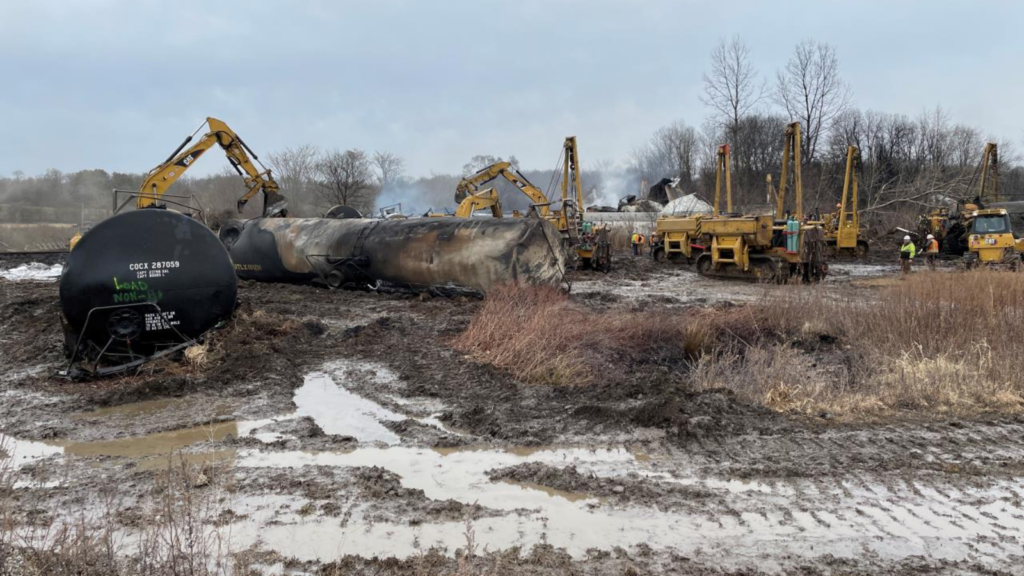
Nearly a year and a half since a Norfolk Southern train carrying hazardous petrochemical materials derailed near East Palestine, Ohio, sparking one of the worst environmental disasters in US history, community members are calling on the Department of Justice to hold a public hearing for the agency’s proposed settlement with Norfolk Southern.
According to the Department of Justice, the settlement requires Norfolk Southern to “take measures to improve rail safety, pay for health monitoring and mental health services for the surrounding communities, fund long-term environmental monitoring, pay a civil penalty and take other actions to protect nearby waterways and drinking water resources.”
Residents of East Palestine, however, contend that the public has largely been excluded from federal decision-making processes. Community members say a public hearing is “an essential platform…to voice concerns, seek clarifications, and contribute to the development of programs that genuinely address the damage [we] have faced,” designating an opportunity for dialogue on long-term monitoring and mitigation plans, adequate compensation, rail safety measures, and meaningful community engagement in the settlement’s implementation.
According to Senior Researcher Nick Messenger, “The Norfolk Southern derailment and toxic chemical spill in East Palestine will fundamentally and negatively shift the economic, healthcare, and environmental trajectory of the region’s residents for decades to come. It would be nearly impossible to fully compensate the community for the long-term healthcare costs associated with slow developing illnesses, for a damaged regional reputation and lost eco-tourism and recreation, and for diminished personal property value. At a minimum, any settlement should be contingent on the afflicted community members having robust input. This includes the opportunity to understand the methods used to calculate the settlement amount and have access to transparent and detailed information about how the terms of the settlement will be implemented.”
The settlement amounts to just over $310 million, including a $15 million civil penalty for violations of the Clean Water Act. The fine represents less than 3% of Norfolk Southern’s $527 million fourth quarter profit last year. As some East Palestine residents question if they’ll ever be able to return to their homes, Norfolk Southern CEO Alan Shaw took home $13.4 million in total compensation in 2023, AP reports.
Designating compensation for impacted residents
Ohio River Valley Institute research illuminates the imperfect assumptions economists use to estimate the ‘cost’ of disasters like the East Palestine derailment, as well as the serious equity concerns with adequately compensating impacted residents. Consistent, quality healthcare and the ability to escape disaster-related pollution, for example, are not equally accessible to impacted populations, yet “cost-benefit analysis and traditional welfare economics offers very little insight into if and how these inequalities should be taken into consideration.”
Norfolk Southern agreed to a $600 million settlement of a class action suit with residents and businesses of East Palestine in April, though the settlement included no mention of any liability, fault, or wrongdoing. The settlement would end all class action claims related to the derailment from residents within a 20-mile radius of the derailment site and cover personal injury claims for residents who live within ten miles of the derailment and opt in, the Pennsylvania Capital Star reports.
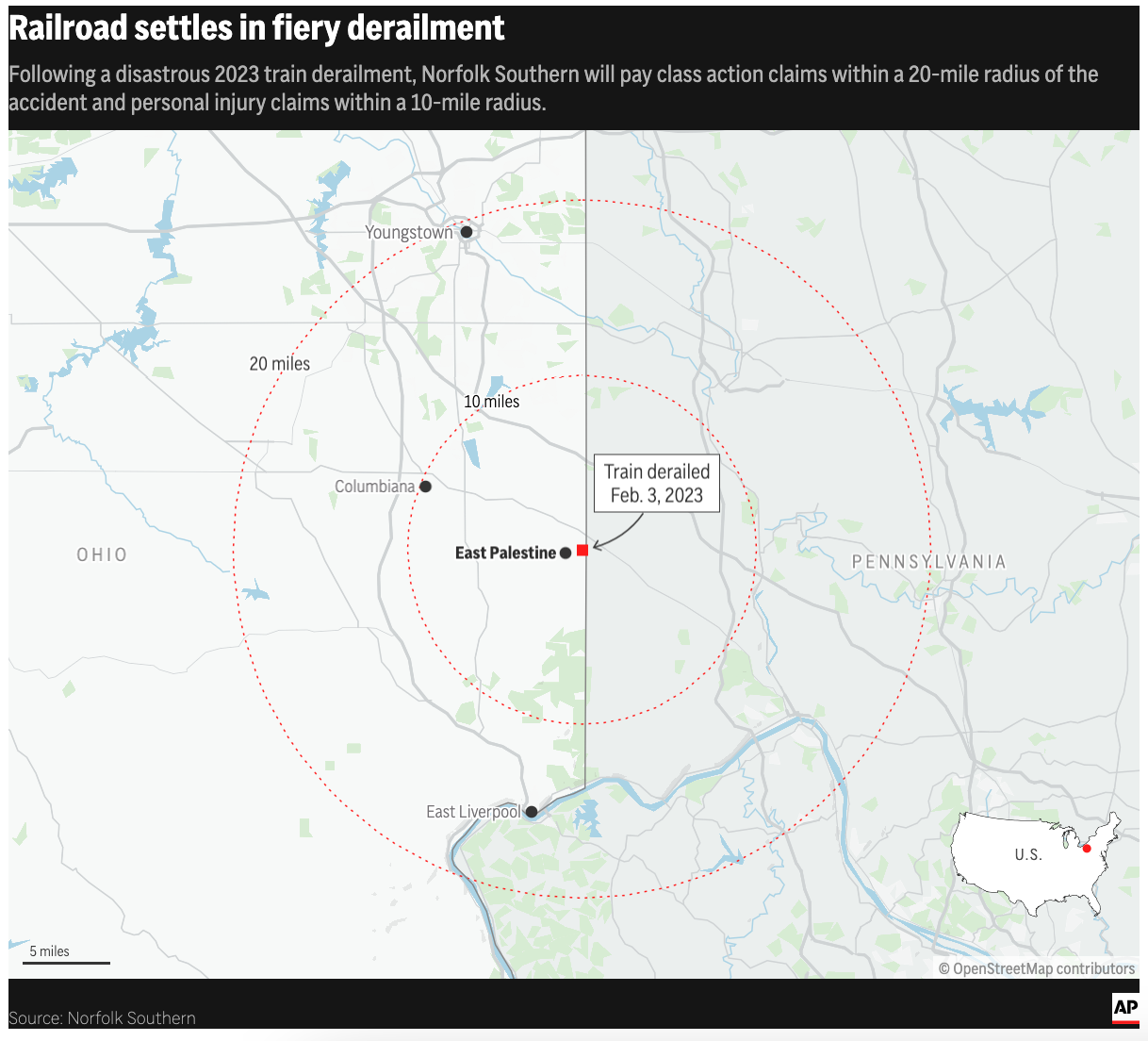
Source: AP, Norfolk Southern
The federal settlement primarily includes money for exams, while the class action settlement includes money for health problems that developed over the past year. Neither settlement addresses the potential of long-term health problems.
New evidence suggests the threat of long-term health harms could have been mitigated. According to a recent investigation from the National Transportation Safety Board, the controversial “vent and burn” of five train cars carrying the toxic petrochemical vinyl chloride was “unnecessary.” The vent and burn, directed by Norfolk Southern, saw 115,000 gallons of vinyl chloride incinerated and released into the environment, affecting at least 16 states and forcing as many as 2,000 residents to evacuate. In the months since, nearby residents have reported serious health conditions, including aggravated asthma, persistent coughing, nosebleeds, rashes, and hair loss.
View our overview & timeline of the Norfolk Southern derailment here.
The agency explained that the decision to conduct the vent and burn rather than pursuing alternative, more time-consuming methods of disposal was “based on incomplete and misleading information provided by Norfolk Southern.” Data show the temperature of the cars was decreasing and not dramatically rising as it would have been if an explosion were imminent. Throughout the investigation, Norfolk Southern withheld critical data and context about the state of the vinyl chloride cars from first responders and elected officials, according to Jennifer Homendy, head of the NTSB, “manufacturing its own evidence” to a degree she deemed “unconscionable.”
Just two days after Norfolk Southern completed the unnecessary vent and burn, the company had resumed running trains through the derailment site.