Coal Plant Orders Cost Consumers Millions & Drive Utility Bills Higher
- Each time a coal plant is ordered to stay open – utility bill rates increase.
- Forcing coal plants to stay open after closure drives up electricity costs because coal power is more expensive to produce.
- In September 2025, the U.S. Department of Energy (DOE) also announced that $625 million in taxpayer dollars would be given to corporate coal plant owners.
- Private energy markets have already decided that coal power is too expensive. According to a 2025 analysis by the financial advisory firm Lazard, electricity from coal-fired power plants costs an average of $122 per megawatt-hour. That same power can be produced for $78 from natural gas plants, $61 from onshore wind & $58 from utility-scale solar. See Lazard LLC’s Levelized Cost of Energy at page 10.
- Forcing coal plants to operate requires consumers to pay higher costs (see below).

Chart from E360 Digest, Yale Univ. Jan. 5, 2026 – A Year of Clean Energy Milestones. Today, wind & solar are cheaper than coal & natural gas. Increasingly, they are boosted by ever more affordable batteries, which have gotten 90% cheaper over the last decade.
Independent National Report on Coal Plant Orders & Consumer Costs
In an unprecedented use of federal authority, President Donald Trump’s administration has invoked emergency powers to force a series of retiring coal plants to stay open. Utilities, states and grid operators have said the aging plants are expensive, in bad repair, and no longer needed to meet regional energy needs. But Trump’s coal plant orders have forced plant operators to continue investing in the facilities – a move that consumer advocates fear could mean billions of dollars in added costs for customers in dozens of states. Trump is forcing coal plants to stay open. It could cost customers billions by Alex Brown – Stateline – March 19, 2026
Coal Plant Orders May Cost Ratepayers $3 Billion to $6 Billion Nationwide
- Energy analysts say Trump’s efforts to keep fossil fuel-powered plants open could become very costly to ratepayers. A recent Report published by Grid Strategies LLC found that as many as 90 aging plants could be subject to similar emergency orders during the remainder of Trump’s term. The Report found that keeping those plants open could cost ratepayers anywhere from $3 billion to $6 billion a year.
- “What the DOE is doing is picking losers, the uneconomical plants that the utilities, the regulators, everybody agreed need to retire & be replaced with something cheaper and more efficient,” said Michael Goggin, who authored the report.
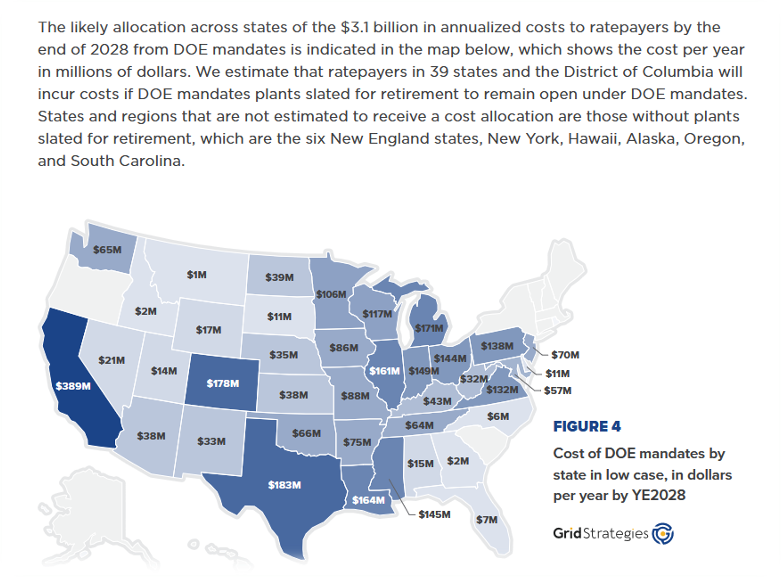
The Report estimated that Pennsylvania consumers alone could pay $138 million in higher utility bills. See, The Cost of Federal Mandates at page 8.
Trump’s Eddystone Power Plant Order Will Cost PA Consumers Millions
A recent Sierra Club Report estimated that the gross cost to operate two Eddystone Power Plant units in Chester County, Pennsylvania to be approximately $34,336 per day. This Report was completed in March 2026 before the Iran War increased the costs of fossil fuels – so this estimate is almost certainly low. The Trump administration invoked section 202(c) of the Federal Power Act (FPA) to force the Eddystone plant to stay open. See Aging Pennsylvania power plant to keep running after Trump order on eve of shutdown by: Jon Hurdle, Inside Climate News – June 9, 2025 – DOE says the plant will help avert an energy “emergency.” Environmentalists say there’s no such crisis.
Eddystone Power Plant’s Owners Will Be Allowed to Charge the Costs of Keeping the Power Plant Operating to PA Consumers.
According to a presentation by Pennsylvania’s Electricity Grid operator, PJM – Constellation Energy will be permitted to charge PA consumers with the additional costs of keeping the Eddystone Power Plant open and is also allowed to charge a 110% profit on those costs. See Education on Federal Power Authority Section 202(c) and DACC Cost Allocation by Thomas DeVita, PJM Legal & Lisa Morelli, PJM Settlements – Meeting of June 10, 2025.
This is because DOE’s May 30, 2025 Order found that an emergency existed in portions of the PJM footprint “due to a shortage of facilities for the generation of electric energy, resource adequacy concerns, and other causes,” & directed that PJM and Constellation Energy take “all measures necessary” to ensure that the Eddystone Units are available for continued operation. See Report Here. PJM explained:
- DOE’s Order directed PJM & Constellation to “file with the Federal Energy Regulatory Commission any tariff revisions or waivers necessary to effectuate this Order,” and further specified that “[r]ate recovery is available pursuant to [FPA section 202(c)].”
- Constellation has communicated its agreement to utilize the Deactivation Avoidable Cost Credit (“DACC”), as described in Part V of the PJM Tariff. PJM is willing to agree on the DACC Credit for the Eddystone Units. See Report at page 9.
- The applicable multiplier for the 1st year is 110% & escalates by 10% each year up to a 150% cap. 110% is the multiplier for Eddystone in 2026. See Report at page 9.
According to Grid Strategies, “Forcing utilities to continue to operate unneeded and costly coal-fired power plants past their planned retirement increases the electric bills paid by homeowners and businesses. It also undermines the competitiveness of U.S. businesses such as manufacturing by raising electric rates.” See Grid Strategies Report.
The same is true for Constellation Energy, the owner of the Eddystone Plant. Constellation made the economic/business decision to shut Eddystone down. DOE’s Order forced it open again. PA consumers will foot the bill for the extra costs created by DOE’s Order. Sierra Club is keeping a running tab of consumer costs for six of DOE’s power plant Orders (including Eddystone).
Case Study on Forced Coal Plant Orders: J.H. Campbell Power Plant
The costs to consumers of forced coal plant reopenings are processed through time consuming and complicated state utility reviews and processes. These cost increases move slowly, but the DOE Orders will allow utilities to charge consumers and ratepayers for the costs of reopening old coal plants. Many of these cost increases are still in process.
However, a May 23, 2026 DOE Order forcing Michigan’s J.H. Campbell coal plant in West Olive, Michigan to continue operating offers a good case study on the actual costs to consumers. See Keeping Michigan coal plant open under Trump orders cost $615K a day by Lucas Smolcic Larson, MLive.com, Oct. 31, 2025. This is because Consumers Energy, the plant owner, has claimed in legal filings that in just over four months, the utility ran up $80 million in net costs to keep the J.H. Campbell power plant on life support. See Trump’s Order to Keep Michigan Coal Plant Running Has Cost $80 Million So Far by Marianne Lavelle – Inside Climate News – October 31, 2025.
Consumers Energy said in its 3rd Quarter earnings report that it would pursue the process laid out in the DOE Order for collecting the J.H. Campbell plant costs. It will seek payment from ratepayers across the Midwest. Even though the peak summer electricity demand season had passed, Consumers Energy said they expect the coal plant Orders “to continue for the long-term.” CEO Garrick Rochow said in a conference call for investors. “And we’re prepared to continue to operate the plant and comply with those Orders.”
Consumers Energy said the costs – $615,385 per day – should be shared among ratepayers (an estimated 42 million to 45 million electricity customers) in the nine states served by the regional electric grid operator, the Midcontinent Independent System Operator (MISO). Consumers Energy had projected that the retirement of the Campbell plant would save its customers $600 million over the next 20 years, or $30 million per year. Instead, running the plant for the past five months has cost close to three times that annual amount.
Michigan Attorney General Dana Nessel, Sierra Club, NRDC, EDF and Earthjustice have filed lawsuits to stop the DOE Order to keep the JH Campbell coal plant from reopening and incurring these forced costs on consumers. See AG Dana Nessel challenges Trump Administration’s order to keep Michigan coal plant open by Steven Bohner – ABC News – December 19, 2025. See Public Advocacy Groups Take Trump Administration to Court for Illegal Coal Plant Extension– Earthjustice – July 24, 2025.
A recent filing suggests the JH Campbell coal plant’s costs may balloon far higher than these original estimates. See Midwestern families on the hook for $180 million to keep Michigan coal plant open under Trump administration’s mandates.
More Background on Trump/DOE Coal Plant Orders and Consumer Costs
13 DOE emergency orders have cost Americans $235M, Sierra Club says – by Robert Walton Senior Editor – Utility Dive – March 18, 2026. DOE’s Orders to keep six retiring fossil-fueled power plants online and are adding millions to customer utility bills, according to the Sierra Club.
Trump Administration Orders to Keep Fossil-Fired Power Plant Running Will Increase Michigan Electricity Costs – NRDC – August 21, 2025. DOE’s August 20, 2026 Order required the J.H. Campbell coal plant to remain operational, despite plans to close the facility by May 31, 2025. An independent report found that keeping fossil-fired power plants, like J. H. Campbell, running could cost consumers $3 to $6 billion a year.
Who Will Pay for the Keystone Generating Station in Armstrong and Indiana counties, and Conemaugh Generating Station in Indiana County?
The April 21, 2026 announcement on the Keystone & Conemaugh Coal Plants Consent Decree does not address details on financing and plans for potential future electricity sales. Because it is not an Order to keep the plants running, the analysis on passing costs onto consumers described above does not apply. Press Releases and news coverage about the Consent Decree appear below. The answer to the question is not yet known.
Shapiro Administration Files Motion to Enter Consent Decree to Maintain Reliable, Affordable Power by Allowing Keystone and Conemaugh Plants to Continue Operating with Improved Environmental Controls and Upgrades – April 21, 2026 Press Release
See Consent Decree. & See DEP Press Release.
- Keeping the Keystone and Conemaugh Generating Stations in operation will allow the facilities to continue generating more than 3,400 megawatts of electricity for the regional grid. This approach allows PA to serve increased demand for energy generation and concerns about reliability, affordability, and economic impact.
- Allowing the plants to continue operating under enforceable environmental requirements will help avoid supply shortfalls that can drive up electricity prices for consumers across the region.
- Shapiro has made lowering costs for PA a central focus of his efforts around economic development and energy, consistently calling for a balanced approach that strengthens the grid, supports economic growth, and protects consumers from unnecessary rate increases.
Gov. Shapiro moves to keep 2 coal-fired power plants open in Western Pa., as energy demand from data centers grows – by Reid Frazier, Allegheny Front · Apr. 22, 2026. Gov. Josh Shapiro announced he was extending the lives of two W PA coal-fired power plants.
Pa.’s largest coal-fired power plants would stay open until 2032 in proposed DEP deal By Peter Hall – Pennsylvania Capital Star – April 22, 2026
DEP Files Final Consent Decree for the Keystone and Conemaugh Coal-Fired Power Plants to Allow for Continued Operation – by David Hess – PA Environment Digest Blog – April 22, 2026. – Provides background information & analysis on the Consent Decree.
Statements on the Consent Decree
Alex Bomstein, Executive Director of Clean Air Council – Here
Ted Kelly, Environmental Defense Fund Lead Counsel for U.S. Clean Energy – Here
Patrick McDonnell, president and CEO of PennFuture – Here
Molly Parzen, Executive Director of Conservation Voters of Pennsylvania – Here
Katie Blume of Conservation Voters of PA (Chair, Clean Power PA Coalition) issued the following statement:
Statewide, PA – The Clean Power PA Coalition issued the following statement from its chair, Katie Blume of Conservation Voters of Pennsylvania, regarding an agreement announced by both President Trump and Governor Josh Shapiro to extend the life of two coal plants that had been scheduled to close in 2028:
We’re extremely disappointed in Governor Shapiro’s decision to allow the state’s two largest polluting power plants, the Keystone and Conemaugh coal-fired plants, to remain operating past their scheduled closing data of 2028.
This decision will not make electricity more affordable. Independent analysis shows that electricity from coal-fired power plants costs twice that of wind and solar. The cost of forcing aging coal plants to stay open is paid by electricity consumers: the cost of keeping open a major Maryland coal plant is estimated at $1.5 billion. That’s being passed on to consumers across the region, including Pennsylvanians (see Note below).
The deal to extend the plants’ operations was announced as part of the governor’s “all of the above” energy policy. Thus far, that “all of the above” strategy has meant blocking Pennsylvania’s participation in the successful Regional Greenhouse Gas Initiative, a benefit to the coal and gas industries, and the extension of two expensive and dirty coal plants. But a true “all of the above” strategy must include “all” sources of energy, including renewable sources like solar and wind, and battery storage, all of which are cheaper and quicker to deploy than fossil fuels, as well as energy efficiency measures to reduce demand.
As energy prices continue to rise, in large part because of the state’s overreliance on costly gas and coal, Pennsylvanians still await action by the governor and the legislature to increase our energy supply by expanding cheaper clean energy, which currently provides only 3% of the state’s power. Until then, “all of the above” will be nothing more than an empty political slogan.
Note on Brandon Shores as ordered by PJM to stay open.
“In January 2025, PJM reported that Exelon had updated its cost estimates for the Brandon Shores deactivation projects, doubling the costs from $740 million to more than $1.5 billion.” The Brandon Shores deactivation projects include expanded transmission lines and additional facilities (such as static synchronous compensators or STATCOMs) for reactive services and other improvements to address the potential for voltage collapse.