

In a “minibus” bill released by the House Appropriations Committee this week, legislators are attempting to loot $500 million from the bipartisan fund used to clean up the country’s land and water polluted by coal mining. The bill would transfer $500 million in previously appropriated cleanup funds to pay for other federal programs.
Since 1977 the Abandoned Mine Land (AML) reclamation fund has helped clean up nearly one million acres of land and water damaged by the coal industry, according to our 2021 report. Until the 1970s when this fund was created, coal operators weren’t required to clean up the impacts of their mining practices and often abandoned mining sites without any remediation. As a result, damage from historic mining – including clogged streams, water pollution, mine fires, landslides, gases leaking from mines, and deforested land – accumulated for more than a century.
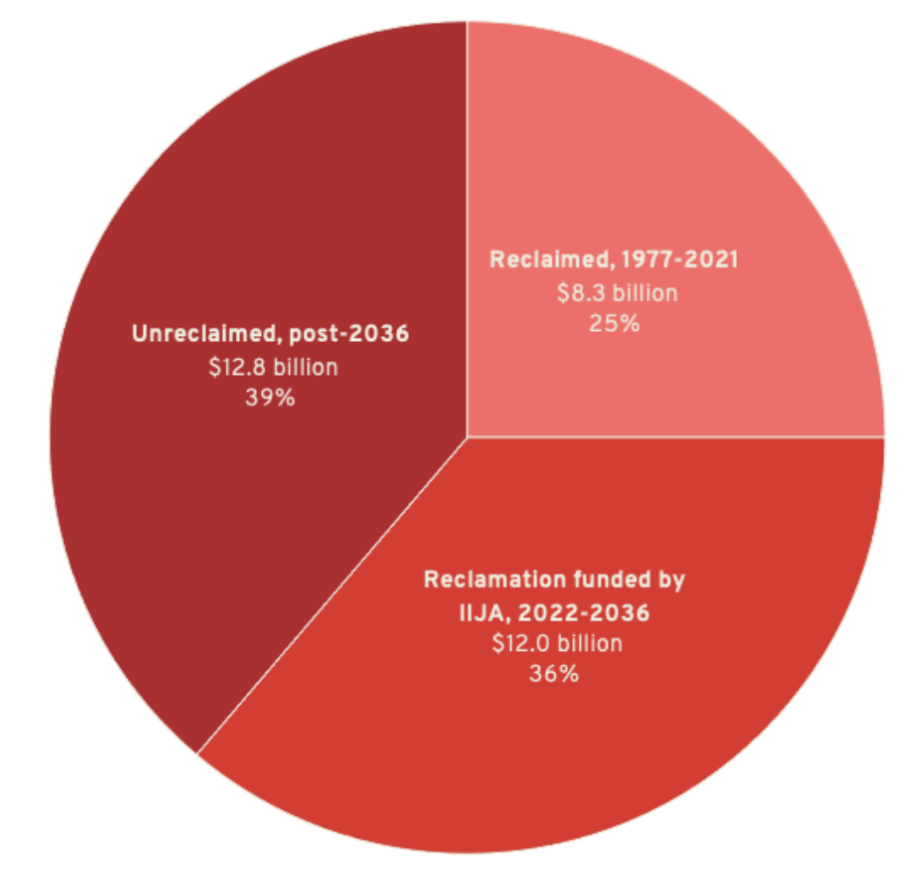
Congress created the AML fund in 1977 to clean up the mess that had been left by the industry, but for most of its history the fund has remained severely underfunded relative to the massive backlog of unremediated damage. And then in 2021 the Bipartisan Infrastructure Law (BIL) reauthorized the program with a $11.3 billion investment over fifteen years. While a historic investment, analysis from Ohio River Valley Institute shows that this $11.3 billion won’t come even close to solving the country’s abandoned mine problem. Based on estimates from our 2021 report, around two-thirds of the outstanding mining damage will remain unremediated even after spending all of this $11.3 billion.
Breakdown of total AML reclamation cost by reclamation status
The new bill from the House Appropriations Committee would remove $500 million in funds that were previously appropriated to the Abandoned Mine Reclamation Fund in the 2021 Bipartisan Infrastructure Law in order to fund other programs across the new bill, including $354 million for the Department of Interior’s Wildland Fire Management program and $146 million for operations of the Forest Service.
Americans shouldn’t be forced to choose between cleaning up hazardous coal mines and funding Forest Service and fire management programs. It is unacceptable that Congress would renege on a promise it made in law to the residents of coal communities just a few years ago.
Unremediated mining damage has festered since at least the 1970s. Residents have been waiting decades for this program to unclog the stream that could flood their property, for example, or stabilize the underground mine that’s threatening their home’s foundation. Revoking $500 million will mean residents will be forced to wait even longer as the threat of these problems continues to grow.
To provide some context, $500 million is roughly equivalent to the AML funds provided to 23 states and tribes in 2025 under the Bipartisan Infrastructure Law. $500 million could finance the stabilization of around 10,000 acres of subsidence, which occurs when land above underground mines caves in.
The AML fund is not a general purpose slush fund. The law is clearly written so that these funds can only be spent on remediating the damage from historic coal mining, prioritizing the problems threatening the health and safety of nearby residents. Most of these funds make their way to construction contractors–and ultimately their skilled trades workers, like construction laborers and operating engineers–who complete reclamation projects in the field. The AML funding in the Bipartisan Infrastructure Law creates or supports thousands of jobs annually.
The millions of Appalachians who live within a mile of mining damage have already been wronged once, when these mines were first abandoned by coal companies. If Congress were to now abandon the promise to put this $500 million toward cleaning up that mess it would only add insult to injury. Congress should be finding ways to reinforce this program, not raid it.