
Recently, a new form of energy has generated lots of buzz in the Ohio River Valley and across the country: hydrogen. The federal government is pouring billions of dollars into new hydrogen “hubs” that would bring large-scale production to our region and several others across the country. Fossil fuel companies bill hydrogen as the “clean” fuel of the future. But the truth is more complicated. Can hydrogen really help decarbonize our economy? Is hydrogen really worth the hype, or is it another false fossil fuel industry promise, like the fizzled petrochemical boom or the defunct ethane storage hub?
To answer these questions, you have to start from the source. The usefulness, cost, and carbon footprint of hydrogen can vary dramatically depending on how it’s produced.
The colors of hydrogen
Today, nearly all hydrogen on the market is made from fossil fuels. Gray hydrogen is made from fracked natural gas. Hydrogen molecules (H2) are separated from the methane in fracked gas (CH4) in a process known as steam methane reforming, or SMR. Some hydrogen reforming facilities plan to use a newer, more efficient process called autothermal reforming, or ATR. But either way it’s produced, gray hydrogen releases a significant amount of carbon dioxide (CO2) emissions. It’s dirty, highly polluting, and bad for the climate.
In the Ohio River Valley, a group of companies known as the Appalachian Regional Clean Hydrogen Hub, or ARCH2, are moving forward with plans to produce blue hydrogen. Like gray hydrogen, blue hydrogen is made from methane using SMR or ATR. Unlike gray hydrogen, blue hydrogen uses costly, experimental carbon capture technology to trap some carbon emissions and store them underground. (As we’ll explore in later blog posts, carbon capture technology isn’t as effective at capturing carbon as many industry leaders say, and it comes with a whole host of safety risks and economic questions.)
Both gray and blue hydrogen depend on methane gas as a “feedstock”, often from fracked natural gas. Plans to build hydrogen facilities in Appalachia would mean even more fracking in our communities. Fracking creates lots of dangerous air and water pollution, and the methane released from drill rigs and pipelines can be far more damaging to the climate than carbon dioxide. New studies from the University of Pittsburgh and the Pennsylvania Department of Health show that living near fracking activity puts children at a higher risk of developing asthma and lymphoma, a deadly type of cancer.
But green hydrogen can be made from water in a process that’s clean, safe, and produces zero carbon emissions. Electrolysis splits hydrogen from water molecules (H2O), releasing oxygen, the air we breathe. Electrolysis powered by renewable energy, like wind, solar, or hydropower, can produce hydrogen with zero climate impact under the right conditions — ensuring that the renewable energy powering electrolysis comes from new sources, is generating power at the same time hydrogen is being produced, and is locally sourced, also known as the three pillars framework. Green hydrogen isn’t quite market-ready, but analysts suggest it could be even cheaper than blue or gray hydrogen by 2030.

How should we use hydrogen? Where is hydrogen a bad idea?
As global emissions continue to rise, it’s more important than ever to scale back the amount of carbon dioxide we release into the atmosphere. But even truly clean hydrogen — electrolytic hydrogen produced using the three pillars framework — only makes sense for use in specific sectors.

Why? Hydrogen can hold a lot of energy, especially when it’s liquified. But it’s difficult and very expensive to produce, and, for most industries and purposes, the best, easiest, and cheapest way to decarbonize is by building out clean, renewable energy for the power grid, like wind and solar.
Michael Leibrich’s “hydrogen ladder” demonstrates where hydrogen can play an important role in decarbonizing our nation’s economy. It also shows where hydrogen should not be used.
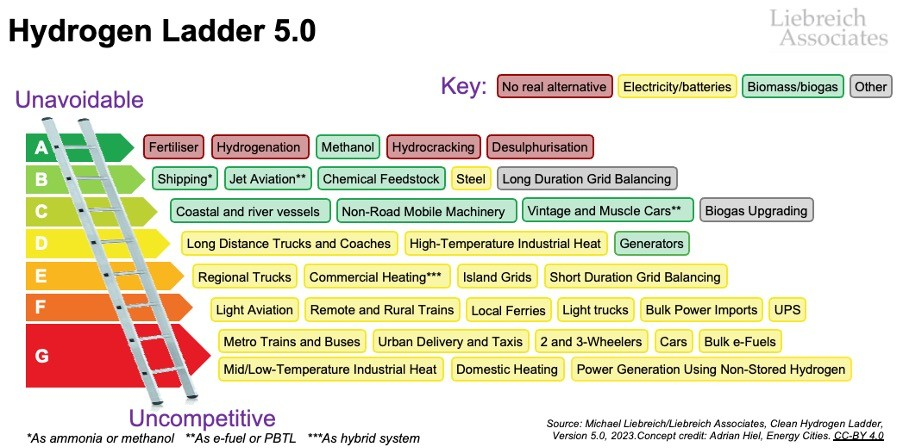
As the ladder demonstrates, green hydrogen makes sense for use in certain top-rung sectors that are difficult to electrify, like long-haul trucking, aviation, and steel and cement production. These sectors require dense energy sources or high heat. Here, renewables-powered green hydrogen is our best bet for lowering carbon emissions.
But even green hydrogen should not be used for low-rung applications, like heating buildings, powering cars, trucks, and taxis, or generating utility-scale electricity. For these applications, better, cheaper alternatives already exist. Heat pumps powered by clean electricity are a far more efficient solution for our homes and buildings, using 80% less energy than hydrogen. Electric vehicles powered by batteries are cheaper, perform better, and are easier to refuel than hydrogen fuel cell vehicles. And the best way to decarbonize our power grid is to build out renewable energy sources, like wind and solar, which are actually cheaper to develop than gas- or coal-fired power plants.
Stay wary of fossil fuel industry hype for hydrogen. If it’s made using fracked methane, hydrogen can harm our communities, prolong fracking, and waste taxpayer dollars. But if it’s made with clean, renewable energy, green hydrogen could play a critical role in niche sectors of a decarbonized economy.